Tuesday, July 31, 2018

Inked: The Believer & Tattoos

Hillsong Pastor Carl Lentz bares tattoos on his arms and believes
they're not a sin to have. 
Tattoos. For many it's an art form for others it's a sign of rebellion. For many believers, it's a desecration of the temple of God. This usually stems from Leviticus 19 where various laws are being mandated by God at that time. Most of these are understandable and common sense to the believer:

  • Don't make idols/gods (Lev 19:4)
  • Don't steal or lie to one another (19:11)
  • Don't pervert justice or show partiality (19:15)
  • Don't gossip (9:16)
All these again, are relatively tame and are still adhered to by believers (or at least they should be). Then there are some that are a bit more confusing and some may not necessarily understand what God was trying to say. While parts of the list are 100% followed by believers, there are others that some are not sure what to do with. Example

  • Do not plant your fields with two kinds of seeds (19:19)
  • Do not wear clothing with two kinds of material (19:19)
  • Do not cut hair at the sides of your head or clip of the edges of your bear (19:27)
John Cooper the lead vocalist of Christian Rock Band Skillet
possesses many tattoos including one his forearm that says "forgiven"
And then, of course, the one this blog is about Leviticus 19:18 "Do not cut your bodies for the dead or put tattoo marks on yourselves. I am the Lord." So what does listing out the others have to do with tattoos? Context. Context is incredibly important. Why wouldn't God want us to get a haircut? We have to look deeper. The who, what, when, where and why. At the time many were cutting their hair in patterns and styles to appease pagan gods. Most scholars agree to this. As many people during biblical times (and maybe still today) did particularly peculiar things to please the gods they believed existed. This, of course, includes tattoos and piercings. There is no doubt many pierced, cut and gashed themselves to please whatever deity they were worshiping and also it's no surprise many were marking themselves as well for the sake of pagan worship and also in honor of the dead. Now, I recently just got a haircut (or a shape up specifically). I don't believe I dishonored God by doing this nor do I believe I was worshiping anything. I certainly wasn't praising my barber, Pablo. I didn't get a haircut to worship a demigod or demon or to honor a dead person. I did it to have myself well kept and clean looking.

Christian artist Plumb holds a tattoo of a feather
and doves. 
Piercings are the same thing. I don't think piercing my ears back in 2016 is equivalent to the mutilation that pagan worshipers did back then to themselves. Also again, I did this because I wanted the earrings because I thought I looked good in them (I think). Something to also consider if Leviticus condemns piercings why does God speak positively of piercings later in Ezekiel 16? If we believe the Bible doesn't contradict itself that must mean context is being used to place things in the right perspective. Tattoos, however, are a bit more tricky. If someone (a believer) decides to tattoo out of rebellion or to get attention than that is an issue and is an offense to Kingdom. It must be weighed very carefully and well thought out. A tattoo is a permanent mark on your skin and while yes it is possible to later have tats removed it can be more expensive to remove than to get. Consider your professional career. Will your job allow you to work with visible tattoos? Some employers are more lenient than others. Of course, the most important thing is to consider the conviction in your heart.


Christan Rapper & Reggae artist Benjah sports many tats.
Just because you admire tattoos doesn't mean you have to get one yourself. Just because your friend who is also a Christian/Believer has a tattoo (while still being a Christian/Believer) doesn't mean you have to. Maybe they believe they got the ok from God but doesn't mean you will. Pray about it. I told my local youth when it comes to tattoos, that boils down to their relationship with God, prayer and heavy consideration. Would I personally get a tattoo? I have not ruled it out entirely but it something I don't feel like I need right now. However, if I become interested in one I know to put it heavy into prayer because in the end, I want to honor God in everything I do. Not to say believers with tattoos aren't honoring God it's just I want to make sure I got the ok if that time ever comes.

For more information check out this link here

What do you think?

Should believers get tattoos? Even if it's something tame like flowers, quotes, etc?

Should we ignore context when reading scripture and take it all in face value?

Do you think tattoos make people less Christian than those who aren't?

Are they less loved by God? Why or why not and do we love them less?

Would you get a tattoo?

Follow William Horseman on Social Media

Facebook.com/bewarethehorseman
Instagram.com/bewarethehorseman
Twitter.com/BTH_215


Friday, July 27, 2018

The Cursing Christian

Do not let any unwholesome talk come out of your mouths,
but only what is helpful for building others up according
to their needs, that it may benefit those
who listen.
Ephesians 4:29

Let's talk about it, Darn it! Alright, so when asked should Christians curse the resounding answer is NO. However, we should ask ourselves what is cursing? is the same as swearing? does cursing involve curses or any form of witchcraft? So when we look at googles dictionary, the primary definition of cursing is "Invoke or use a curse against." It's clearly talking about curses in terms of sorcery. The 2nd definition is the more familiar one "Utter offensive words in anger or annoyance." Swearing's definition is more simply "the use of offensive language." The oldest dictionary we have access to online is the 1828 websters dictionary and that defines cursing as "Execrating, imprecating evil on; dooming to evil, misery or vexation." Nothing to do with language. What about in the Hebrew? or Greek? Yep, both are defining curse in the same way our definitions do. To place a curse on something. So if these are the definitions of cursing, are the words themselves curses? 

An artist depiction of the Apostle Paul. According to some
scholars Paul may have used the word sh*t to emphasize
a point he was trying to make in Philippians 3:8
Now we know a** is used in the bible to describe a donkey. In our time and culture, it can also be used to describe a stupid person and even more commonly the butt. How often do we use this word? Is it an offensive term? Why is it offensive? Another word is sh*t. Again looking at the etymology of the word shows that it does mean poop. We changed it later to basically be a noun (person, place or thing). Interestingly enough some theologians and scholars believe the Apostle Paul used this word in Philippians 3:8. Some Bible translations have the words garbage, waste, dung, etc however in the Greek translation we see the word "Skubala" which translates closely to the word sh*t. Now I'm pretty sure the church will not allow these words to be used within the temple regardless of context. I remember a couple of years ago a preacher came to my church and used the word b*tch to refer to the actual meaning of the word which is a female dog. Regardless, you could feel the uneasiness in the church after he said that word. We never saw him again.

Alex Faith an established Christian Hip Hop artist who recently
released a song called "Tension" where he uses the word sh*t
caused a stir in the CHH community.
Of course, there's the notorious F-word. I used to say this word when I was younger but it never felt right coming out of me. I couldn't tell you the last time I used the word. Yes, I'm able to carry conversations, arguments, discussions and do music without dropping an "f-bomb." Something that seems more and more impossible today. My personal beliefs: People who use the F-word show a degradation of character. The word all in all is pointless. The meaning literally means sex. The origin goes back to the 16th century where the word is pretty much the same and it's meaning. It may have come from an Indo-European root meaning "to strike" but that's up in the air. Some people just like saying the word because it "feels good to say" but it's frowned upon heavily and considered vulgar. Vulgar defined is "lacking sophistication or good taste, unrefined." The 2nd definition is "making explicit and offensive references to sex or bodily functions." Historically it basically meant "language of common people." Some of these words are considered not bad at all. Others? Should be kept out of the mouth of the believer. The bible says don't let unwholesome talk come out of the mouth (the verse above this blog) but seeing one of the most cited figures in the scripture possibly used the word sh*t what unwholesome talk is the verse really referring to? I personally believe certain words aren't vulgar or bad. I also personally believe some words don't need to pass the lips of the devout believers (i.e. b*tch & F**k). What do you think?

Should believers curse? even if the meaning of the word is actually inoffensive?

Are Christians who curse less of a Christian than those who don't?

What about offensive gestures? Middle fingers, Bras D'Honneur. etc?

What if our words and gestures are inoffensive to Christians in other parts of the world?

Follow William On Social Media
Facebook.Com/BewareTheHorseman
Instagram.Com/BewareTheHorseman
Twitter.Com/BTH_215

Tuesday, July 17, 2018

Fat Acceptance: The Christian Perspective

Do you not know that your bodies are temples of
the Holy Spirit, who is in you, whom you have
received from God? You are not your own.
1 Corinthians 6:19

Hi! This is me. I'm a big man myself so I
think I can talk on this a little.
So just in case, you're wondering (for those who don't know me personally), how can I talk on this subject? Well, I'm a big person myself. Now I only recently heard of the fat acceptance movement. Maybe a little over a year ago and I thought it was a bit...odd. I'm not sure what these people are exactly fighting for. I'm guessing acceptance given the name but acceptance of what? being fat? Like I said I don't know so I dug a little bit and was a little surprised by my findings. It seems as though a majority of these people (mainly women) want the world to embrace them in their large sizes and wants to accept their lifestyle as a healthy one. That calling them unhealthy, unattractive and more is a form of hate speech. In a time where nearly everything offends everybody I shouldn't be surprised but being this is closer to home for me I guess that's why I'm choosing to talk about it. 

Though it sucks and isn't necessary no one is obligated to be
kind to us
Now, I agree 1000% that we ALL should treat each other with decency. Respect me and I'll respect you. It's basic etiquette. However, the unfortunate reality is no one is OBLIGATED to be kind to you. If someone had a bad day and is taking it out on everyone and their mom it may not be needed but it isn't illegal. Other times some people are just rude for the sake of being rude. They like insulting people sometimes for their own entertainment. This can be done by trolls behind the safety of their computer/phone screen or people bold enough to insult you in your face because you know "you're fat and you can't catch me." I wish we could be more kind to one another. Insults aren't necessary
even if it's grounded in truth. Yes, I'm fat. I'm aware and you don't have to tell me that every time you see me. I've been bullied because of my weight, called everything from "Free Willy" to "Yokozuna." I've been dealt the "you're so fat..." jokes to personal jokes regarding my body. It hurt, I didn't like it, I do believe it played a part during my time of suicide ideation but the truth is even though bullying is heavily frowned upon today and is more times than not punishable, no one can really be stopped and THAT'S something we big people have to accept.


No one has to compliment you for being big and confident. If you are, great! I'm happy for you but that doesn't mean everyone else will be. I've been called disgusting, given stank faces when in public and whenever a school bus full of kids drove by I knew I was getting commentary but I expected it because common decency isn't a law. Another thing is no one is obligated to be interested in you romantically. Yes, people should look beyond the physical, that's highly desirable but the truth is
people DO look at your body. There's a reason why women stare a little longer when a ripped guy walks around without a shirt. There's a reason why when women walk by in clothes that hug their body men look a little longer. We naturally look at the body. Now yes, there is a community of men who appreciate bigger women but some ladies in this group want ALL men to give them chance at dating and that might sound nice on paper but this violates a persons right to have preferences. I'm in the minority as a large portion of women don't flock to big men as often as men to big women. I understand that I can't force a lady to like me. If she's not into big men, that's the end of it.

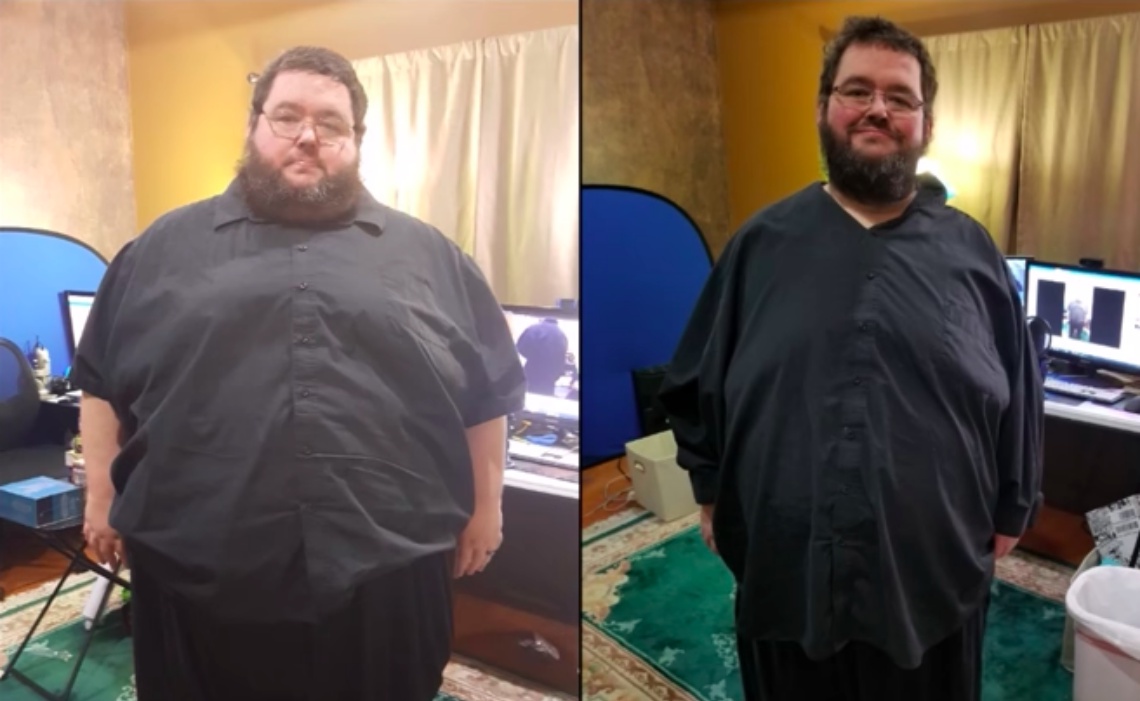
Steven Jason Williams (aka Boogie2988) once weighed 587lbs.
After gastric bypass, Steven has lost well over 200lbs.
Thirdly, I cannot and will not endorse an unhealthy lifestyle. Yes, I know that there are SOME big people who are big and healthy for the most part. I've been fortunate enough to be big and not have any issues with cholesterol, high blood sugar, etc. However, this doesn't mean I have won't have complications in the future if I don't tend to my weight. As a Christian, the Bible tells me my body is the temple of the spirit and that doesn't mean a bigger body means the spirit is in a mansion. Also, I want to live as long as I can. I'm fully aware tomorrow is not promised to anyone but that doesn't mean I should abuse the days I'm still here by endangering my health. Being big, fat, obese, morbidly obese, etc is not healthy. I'm sorry but it's true. Our bones will suffer faster, feet will hurt more, our hearts are working harder and it's just not healthy. I remember a quote from a Youtuber some may know as Boogie2988 (pictured above). He was quoting someone else but it stuck with me, he said: "There's a lot of old people, a lot of fat people but there's not a lot of old fat people." That was a sobering thought. So, in the end, I support the idea of treating everyone like a decent human being but I do not support that people should be forced to like, date or accept you. I refuse to say being fat is OK when it's not. Outside of medical reasons that may cause weight loss difficulty if you can lose the weight, you should. When I had lost only 30 lbs I felt better, had more energy, was more alert so imagine if I lost 100 or more? I'm not saying anyone is ugly for being big because there are beautiful plus size women but with extra weight, we can possibly carry more risks that may take us to the grave sooner than we should and no amount of beauty, positivity, social media followers or an acceptance movement will change that.

What do you think?

Is the fat acceptance movement a good thing? Why or why not?

Is someones weight a deal breaker in terms of dating?

Should the church discuss health issues or is that too personal?

Follow William Horseman on Social Media
Facebook.com/BewareTheHorseman
Instagram.com/BewareTheHorseman
Twitter.Com/BTH_215
WILLIAM is no longer on SnapChat (as of 07/17/2018)

Tuesday, July 3, 2018

And The Award Goes To: Are Christian Award Shows Needed?

CCM artist TobyMac won 4 Dove awards
including Artist of the Year in 2013
It's often frowned upon when believers look for the admiration of man. You'll often hear "I'm not here for man's approval but for God" or something to the gist of that. So let's talk about award shows. We got the Grammy's, the Oscars, the Emmy's, the Daytime Emmy's, Kids Choice Awards, Teen Choice Awards, MTV Awards, BET Awards, and the list keeps going. These particular award shows however seldom feature Christian/Gospel content. Maybe a nomination here or there if the person/song/media is known enough but people of the faith are often never highlighted. This is where Christian Award shows come in. The Stellar Awards, The Dove Awards, The Kingdom Choice Awards, The K-LOVE Fan Awards and more. Now, in all honesty, there's nothing wrong with being recognized by your peers. When you work a job and they enjoy the work you do, you may be given a bonus, a plaque or some other kind of incentive. You may even get some applause or a pat on the back. Whether you want to hang the plaque or display the award is up to you but receiving it isn't wrong neither is being proud of the work you've done. However, in terms of music, especially faith-centric music, this should be approached a lot more gently. I personally have no problem with a Christian artist receiving an award for their work. After all, most artists at these award shows are not idle in their local church singing every Sunday. These are signed artists that—despite being Christian/Gospel artists—tour internationally, sells hundreds of thousands of albums and are usually winged under some major label or distribution group. So because of this, their gonna rub shoulders with some top-tier people in the industry and have their names mentioned come award season.

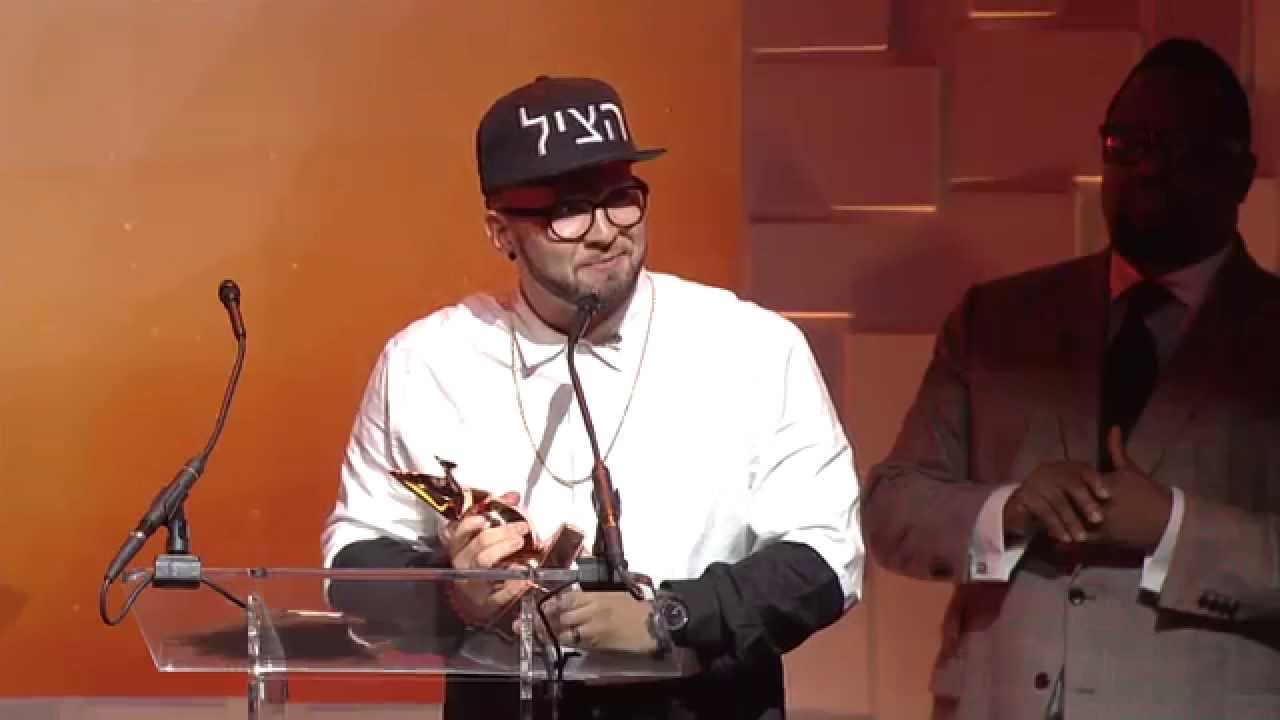
Hip Hop artist Andy Mineo won the 2014 Dove Award for
Rap/Hip-Hop album of the year for his EP "Never Land"
For me, I actually have 2 problems with Christian Award Shows (for now we'll just call them CAS's). My first issue is the award itself can plant a seed of pride in an artist. Sure, when we're receiving any kind of award we should receive it in humility and thankfulness. After all, the gifts of music belong to God. We're just entrusted with the gifts to lift his name and make him known. However, a person can easily receive the award like "Wow...I'm THE artist of the year! I beat everyone else!" and this can manifest a spirit of pride in even the most spiritual person. I've heard a story of a certain faith-based artist (I won't mention the name) who has sold thousands of records and because of this, the person began to DEMAND things like first class flights, 5-star hotel accommodations, bowls of fresh fruit and more. God forbid this artist began to win awards (I don't know if they have or haven't) but they have completely disregarded that it was the gift God gave them that launched them into "full-time ministry" and now behave no better than a well-off secular artist. It's not wrong to have 1st class or whatever but we must remember no matter how far the Father may take us, we're still servants and we're meant to serve. That should be carried with humility. 

Gospel singer JJ Hairston & Youth Praise won several Stellar
Awards this year (2018)
My 2nd issue is the process of the award show. What I mean is the categories of the award itself. "Best" Male Singer,  "Best" Group or Duo, "Best" Album, etc. When you say "best" it means the rest are lackluster. That may not be the intention of the show but remember we're dealing with human emotion and feelings. Like I said previously, even the most spiritual may get a little disappointed when their name isn't called to the stage. Thoughts that aren't so good may pop up too like "He/She is the best? Why? The song/album wasn't really that good. Oh well, better just smile and clap." I've heard different artists from different genres whether jokingly or not say "I hope I win" or some variation of that. I think award shows are a blessing and a curse. An award can certainly encourage a person and show the artist the message God put in them is being heard on a grander scale but it also can infect the person with pride, jealousy or a drive to be better only because they want to win an award in the future. Not necessarily because they want to win souls. What do you think?

Should Christian artists get recognized for their work via Award ceremonies?

Is it wrong to acknowledge the artist's work or ministry? Why or why not?

Do you believe the validation of a calling is needed for a believer? 

- William

Follow William Horseman on Social Media
Facebook.Com/BewareTheHorseman
Instagram.Com/BewareTheHorseman
Twitter.Com/BTH_215


A Conversation: LGBT

The following conversation was given consent to share online. The name of the original person asking these questions was changed to protect...